
When Google launches a Pixel phone, the tech world pays attention. The Pixel 10, launched on August 20, 2025, is no different. On paper, it looks like an evolution: faster chip, brighter screen, better AI features, and a camera system that’s both familiar and new. But what does that actually mean for you and me in daily use? That’s exactly what we’re breaking down in this blog.
Instead of just throwing numbers and jargon, I’ll explain the Pixel 10 the way I’d explain it to a friend who’s considering an upgrade. We’ll cover its specs, display, processor, cameras, battery, network, features, price, pros, cons, and finally a quick FAQ to clear up common questions. if you wnat to checkout Google Pixel 10 Pro Fold just click here,
So grab a coffee (or your phone charger 😅) — let’s dive in.
Specifications: What’s Inside the Pixel 10
Think of the Pixel 10 as Google’s answer to the iPhone 16 and Galaxy S25. It runs on Android 16 with Google’s fresh Material You 3 design. At its heart is the Google Tensor G5 processor, built on TSMC’s 3nm process. This is important — earlier Tensor chips were made with Samsung, and they had issues with heating and efficiency. With TSMC, Google is promising faster speeds and better battery life.
Memory-wise, you get 12GB of LPDDR5X RAM, paired with either 128GB or 256GB storage (no microSD card slot here).
For the first time in a base Pixel model, you’re getting a triple-camera setup: wide, ultrawide, and a telephoto. It also supports dual SIM (nano SIM + eSIM globally, though the US is eSIM-only).
📦 In short: it’s a solid flagship package, but let’s unpack each part.
Display: Brighter Than Ever
The Pixel 10 has a 6.3-inch Actua OLED display, with a 1080 x 2424 resolution and 422 pixels per inch. Translation? Sharp, crisp visuals for everyday use — whether you’re scrolling Instagram or watching Netflix.
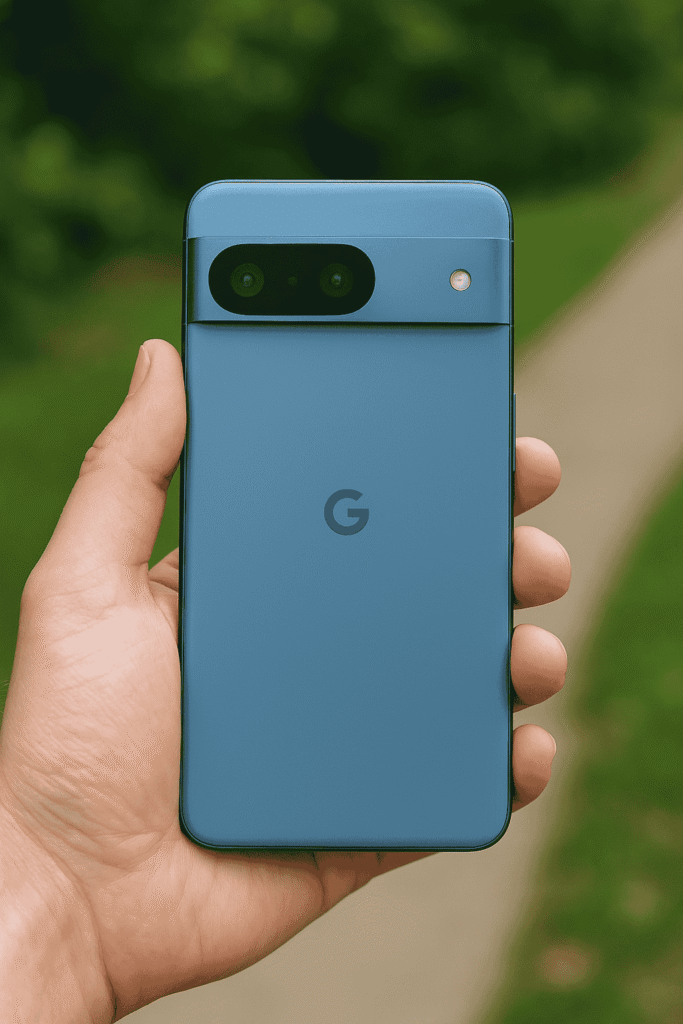
What stands out is brightness. The screen can hit 3,000 nits peak brightness, compared to around 1,500–1,800 nits in older models. That’s huge. If you’ve ever struggled to see your screen under bright sunlight, this solves it. HDR content (like on YouTube or Disney+) looks fantastic because the screen also supports HDR and 24-bit color depth.
The refresh rate goes from 60Hz to 120Hz, adjusting depending on what you’re doing. Scrolling through Twitter/X feels buttery, while static images save battery by dropping the refresh rate. The screen is protected by Gorilla Glass Victus 2, so everyday scratches and drops won’t instantly ruin it.
📱 Real-life benefit: No more squinting at your phone on a sunny day.
Processor: Tensor G5 Power
The star of the show is the Google Tensor G5 chip. It’s built on TSMC’s 3nm process, which is a big deal. TSMC makes Apple’s A-series chips, so you know efficiency and performance are top-notch.
Specs-wise, it’s an octa-core chip:
- 1x Cortex X4 (3.4GHz) for heavy lifting
- 5x Cortex A725 (2.85GHz) for balanced tasks
- 2x Cortex A520 (2.4GHz) for efficiency
The GPU is a Mali-G715 MC7, which is good for gaming, though not the best in class (still behind Apple’s A18 and Snapdragon X3).
But here’s where Tensor shines: AI tasks. The TPU (Tensor Processing Unit) is 60% more powerful than last year. Things like real-time translation, photo editing, and voice recognition happen much faster and on-device.
🔑 In plain words: Apps open quicker, multitasking is smoother, and AI features feel less like gimmicks and more like tools you’ll actually use.
Main Camera: Triple Lens for the First Time
Pixel phones are known for their cameras, and the Pixel 10 finally gets a proper triple-lens system on the base model:
- 48MP main camera (f/1.7)
- 13MP ultrawide camera (f/2.2, 120° FoV)
- 10.8MP telephoto camera (f/3.1, 5x optical zoom)

The main sensor is actually smaller than the Pixel 9’s 50MP, which might sound like a downgrade. But thanks to computational photography + the Tensor G5 ISP, photos still look sharp, detailed, and color-accurate.
The big upgrade is the telephoto lens. For the first time, you get 5x optical zoom on a base Pixel. Add Google’s Super Res Zoom and you can stretch that to 20x digital zoom with surprisingly good results.
📸 Real-life example: You’re at a concert, and instead of recording a tiny dot on stage, you can zoom in and actually capture the performer’s face.
Selfie Camera: Reliable but Familiar
On the front, the Pixel 10 sticks with the 10.5MP selfie camera. It’s got a wide 95° field of view (great for group selfies) and supports 4K video recording at 30/60fps.
The Face Unlock feature works fine in daylight but struggles in low light. So, the ultrasonic fingerprint sensor is your reliable fallback.
🤳 Real-life benefit: Whether it’s TikTok, Zoom calls, or vlogging, the selfie camera won’t disappoint.
Battery: All-Day Confidence
Battery life has always been a question mark with Pixel devices. With the Pixel 10, you get a 4,970mAh battery (minimum 4,835mAh). Google claims 24+ hours of normal use and up to 100 hours with Extreme Battery Saver.
Charging speeds:
- 30W wired charging (55% in ~30 minutes)
- 15W wireless charging via PixelSnap (Google’s magnetic system, similar to MagSafe)
That last part is cool: magnets align the phone with the wireless charger for consistent charging speeds. No more fiddling to find the “sweet spot.”
🔋 Real-life benefit: You’ll make it through a full day easily, and topping up before heading out takes just minutes.
Memory: Smooth Multitasking
The Pixel 10 ships with 12GB LPDDR5X RAM across all variants. Storage is 128GB or 256GB, with no SD card slot.
12GB RAM means you can run multiple apps — Spotify, Instagram, Gmail, YouTube — without things slowing down. And since AI features run on-device, the extra memory ensures the phone doesn’t choke when juggling tasks.
🗂️ Real-life benefit: Perfect for heavy multitaskers and content creators.
Network: Better Modem, Global 5G
One of the biggest gripes with older Pixels was connectivity. Google finally ditched Samsung’s Exynos modem and went with a MediaTek T900 modem. The result? Fewer drops, better 5G speeds, and improved reliability.
You get:
- 5G Sub-6GHz and mmWave (mmWave limited to North America)
- 4G LTE fallback
- Satellite SOS for emergencies (similar to iPhones)
📡 Real-life benefit: Whether you’re in a crowded stadium or traveling, your signal won’t betray you as often.
Connectivity: Covers All Bases
The Pixel 10 checks all the boxes here:
- Wi-Fi 6E (not Wi-Fi 7 yet)
- Bluetooth 6.0
- NFC (for contactless payments)
- USB-C 3.2
- UWB + Thread (for smart home + precise device tracking)
🛜 Real-life benefit: Seamless Google Cast streaming, easy tap-to-pay, and future-proofed for smart home tech.
Features: AI Takes Center Stage
Here’s where Google really flexes: AI integration.
- Magic Cue: surfaces helpful info during calls and messages. Example: If someone texts you about dinner plans, it’ll suggest restaurant details.
- Camera Coach: gives real-time tips when taking photos (“Try stepping back” or “adjust lighting”).
- Auto Best Take: fixes group photos by swapping in the best expressions for everyone.
- Live Translate: translates calls in real time, on-device.
On top of that, you get Titan M2 security chip, 7 years of updates, and Pixel-exclusive safety features like Emergency SOS via satellite.
🤖 Real-life benefit: These aren’t gimmicks — they actually solve day-to-day problems.
Prices: Global Snapshot
- US: $799 (128GB), $899 (256GB)
- Europe: ~€899 (128GB)
- India: ₹79,999 (256GB only)
- Colors: Indigo, Frost, Lemongrass, Obsidian
Sales started August 28, 2025, with availability through the Google Store and major carriers worldwide.
Pros and Cons
Pros:
✔️ Triple camera system (with telephoto)
✔️ Brighter, outdoor-friendly display
✔️ AI features that actually help
✔️ 7 years of software updates
✔️ Magnetic wireless charging (PixelSnap)
✔️ Improved modem reliability
Cons:
❌ Smaller main/ultrawide sensors than Pixel 9
❌ Face Unlock weak in low light
❌ Occasional app crashes (early Android 16 bugs)
❌ Gaming performance not class-leading
❌ No expandable storage
FAQ
Q: What’s the starting price of Pixel 10?
A: $799 in the US (128GB).
Q: How long will it get updates?
A: 7 years — all the way up to Android 23.
Q: Is it waterproof?
A: Yes, IP68 rating.
Q: Does it support wireless charging?
A: Yes, 15W via PixelSnap magnetic charging.
Q: Is it good for gaming?
A: Handles most games fine, but not as strong as iPhones or Snapdragon flagships.
Final Thoughts
The Google Pixel 10 isn’t about flashy specs — it’s about making your phone smarter, more reliable, and easier to use daily. With a brighter screen, telephoto camera, magnetic charging, and powerful AI tools, it feels like a phone designed for real people, not just spec sheets.
If you’re looking for a future-proof Android phone with long-term updates and everyday usability, the Pixel 10 deserves a serious look.
Related Posts: